Shipped
Salpa 0.15.6
While a workflow runs, a single node’s run now waits for it and says why. A number field you clear no longer shows NaN, and the Intel Mac download is now built the same way as the other three platforms.
While a workflow runs, a single node’s run now waits for it and says why. A number field you clear no longer shows NaN, and the Intel Mac download is now built the same way as the other three platforms.
Salpa now names the step a workflow run is on, and runs one node at a time from the canvas, saying why when a second has to wait. It explains why an environment could not be built, and when a workflow carries on past a failed step, it holds back every step that depends on it.
On Windows, a busy computer no longer breaks a run: Salpa gives its own pixi longer to answer, restores it from the app if it is missing, and never swaps it for a download.
On Windows, a run now rides out WSL’s own brief failures: Salpa waits for WSL to recover, retries a step WSL never started, and keeps WSL awake between steps.
On Windows, a run no longer fails when WSL is slow to answer: Salpa wakes WSL and asks again, instead of treating the package’s environment as missing.
On Windows, a package that runs through WSL2 now installs in one go: Salpa puts its own pixi into WSL itself. Until now, on a fresh machine, the package installed without its environment, and its first run failed until you pressed Setup WSL2 Pixi and Create All in Settings under Environments. A run whose environment cannot be built now says why.
If a workflow you have open changes elsewhere, saving no longer overwrites it without a word: the app offers Reload or Keep mine. And Cmd+S (Ctrl+S on Windows and Linux) now saves the workflow.
The assistant, in early access, now prepares a workflow in fewer steps: it sets a template’s shared settings once for every step, and reads a long document by its outline or one section at a time. Its check of the numbers in a reply also reads scientific notation.
Accounts in early access can now rate the assistant’s replies, and can choose to send us a conversation after a preview of what it contains. The privacy notices on salpa.app and on this site say what is sent and how to have it deleted.
The app’s local services now require a per-launch password and accept a per-launch access token. And accounts we have invited to early access can try an assistant beside their projects; the privacy notices on salpa.app and on this site say what it sends and what we keep.
The app’s local server now refuses requests from other websites on every route and on its live connection, not only when it serves files.
Settings and the footer of the Home page now show the app’s own version, instead of 0.0.2, the version of a component inside it, so a tip on the Home feed that needs a newer app can tell. The bundled pdbmdauto is 1.2.8.
A click on a card’s picture now brings it to life in place, as a live view of its structure. And the sign-in window no longer writes your Google sign-in token into the app’s log file.
The viewer opens files of up to 100 MiB at once, a floating window keeps what it showed when the app reloads, and a card keeps the view you chose for it. The app also no longer keeps one processor core busy while it sits idle.
A page for Salpa Foundry, the network we are starting for people who use and build computational methods in molecular science. Its first step, Phase 0, is free and hands-on: we work with a few research groups at a time to get their work running in Salpa, starting with molecular dynamics from a PDB code.
Results in 3D, inside the app. A node’s panel has a View tab that draws the structures a run produced and plays its trajectories on them; a view can float over the canvas in its own window, and a card can show a still of its structure. The app’s local server now answers only to this computer’s own names, and the window writes only the file you chose in the Save dialog.
A computer going to sleep no longer ends a running job. A job’s time limit and the canvas’s checks now count time awake, not time on the clock, and a job that is still running is no longer taken for abandoned when the machine wakes.
An exported template no longer carries a node’s environment path or its last results, so it holds the workflow and nothing from your computer; the export reports any path it could not take out.
A stopped node now stays stopped, on the canvas and when you reopen the workflow, and a run stopped from outside the canvas ends on it too.
Stopping a node that waits on Salpa Compute now cancels its run on our GPUs as well. Large results, such as big structure predictions, now come back through storage instead of being cut off at a size limit. The bundled pdbmdauto is 1.2.5, which rebuilds a modified residue that its PDB file declares.
Your Salpa Compute sign-in token now goes only to the Salpa Compute nodes installed from their own source, and a package cannot claim that source for itself. The bundled pdbmdauto is 1.2.4.
Two fixes. A node’s own environment keeps the networkx version its packages were solved with, where the app had held it below 3.0. And the Boltz-2 and Chai-1 nodes for Salpa Compute save the structure a successful prediction returns.
A workflow’s folder is now asked for or found, never guessed: opening a shared workflow file or uploading a template asks where it should live, and a workflow whose folder has moved offers to locate it. Export saves into the workflow’s own folder, named after it. The status bar no longer reads Offline for the first half-minute after launch (27.8 seconds down to 1.8 in the packaged app), picking a node opens its panel, the side panels follow the window’s width, and one node’s settings no longer become the next node’s defaults.
Undo and redo now follow what you did: drawing, removing and deleting a connection and saving a node’s settings are each one step, and undo, redo and every run keep the backend in line with the canvas. Deleting a connection with a right-click now reaches the backend; it had failed every time. You can edit a node whose package is not installed, an exported template carries the parameters of the graph that runs, and a failed request says why.
Two fixes. A connection you draw from a node of a template, or of a workflow you have reopened more than once, now reaches the backend as soon as you draw it. Before, it showed on the canvas without reaching the backend, so a run started before saving could leave it out. And quitting Salpa while it is still starting no longer leaves one of its background services running after the app has closed: on Linux, where we reproduced it, seven quits out of seven had left it behind.
On Linux, the AppImage now opens in seconds. It had been rebuilding its Python environment every time it started, and it was packed in a way that made every file read slow. On our test mini-PC a later launch took about a minute and a half, and now takes about four seconds; a first launch is down from two minutes to about forty seconds. The download is about 37 MB larger for it. And the Execution History panel now shows how long a run really took, from its first step to its last, instead of the length of its longest step.
On Windows, packages that run through the Linux subsystem now get the same pixi the app itself runs, instead of whichever version was newest on the day it was set up. And when an install cannot finish because that pixi is missing, the message says so and points at the button that installs it, instead of asking you to install the Linux subsystem you already have.
Create All, the button that builds an environment a package could not build when it was installed, never worked in the packaged app: it looked for the package definition inside the app itself, where nothing is ever put. It works now. And when the reason is that the Linux subsystem on Windows has no pixi yet, it says so and offers the button that installs it.
The Python environment Salpa builds on first launch is now installed from a lock file shipped with the app, instead of being solved fresh on each machine. Everyone running a given version now gets the same environment, and updating it is a deliberate step at release time with the test suite run against the result.
Removing Salpa used to leave about twelve gigabytes behind — most of it inside the Linux subsystem on Windows, where no Windows tool ever shows it. The Environments page now lists every environment and package cache the app built, with its size, and clears them in one confirmed step.
Apple Silicon Macs can now actually run the packages that only exist for Intel. Installing them had worked since 0.3.0; running them had not, because the app and the package disagreed about the processor. The app now carries both, which is three megabytes and the difference between a promise and a working node.
A release about the releases: every build now inspects the finished application before it is accepted, and every platform runs a real workflow end to end. Two things had been shipping unnoticed for months — source maps of our own code, and a module quietly dropped from the build.
Two user-visible changes, so a minor bump by the release policy: the app no longer sends usage statistics, and a first run installs one starter package instead of eight. Every download was fetched anonymously and checked before the tag went up.
Jacob joins BoundaryComputing as cofounder, leading business development. He arrives already fluent in the product: eight months of building real workflows in Salpa for his MSc thesis, which means he has met every rough edge personally — as a user, before ever having to explain it to anyone else.
The third patch in five days. The release cadence is now measured in days, not months.
The first minor bump since the preview line began — four months of accumulated sharpening, packaged as a version number people can actually point at.
An afternoon with Prof. Sylvestre Bonnet, hands on: installing Salpa, running workflows himself, and talking through what a working chemistry group actually needs from a tool like this. Cheerful, direct, and full of the kind of feedback you only get from someone using the software rather than watching a demo of it. The best kind of afternoon.
Steady maintenance on the preview line while the 0.2 work lands behind it.
Salpa’s own mark ships inside the app, and the app learns to fetch remote sources over the network. Identity and reach, in the same release.
Salpa CLI 0.5.0: scaffolding a node, building its isolated environment, and actually running it on demo data all become one tool’s job. Followed by two release audits that caught a string of home-directory paths leaking into console output — the kind of bug nobody reports and everybody notices.
The node-authoring CLI goes public on PyPI, five days after its first commit. One command now turns a Python function into a working, testable, installable Salpa node package.
The company site is rebuilt around a near-monochrome system where the only colour on the page comes from the logo. Restraint as a position: the software is the loud part.
The open package collection becomes a public repository — real workflows, real licenses, installable from inside the app. The deliberate choice here is what stays free: the Hub is open, and the compute is what we sell.
A year after the proposal was turned down for being overly ambitious, the thing it described is stable, free, and in people’s hands — built without the grant. Not to relitigate a review — just a note that sometimes the fastest way to de-risk a vision is to ship it.
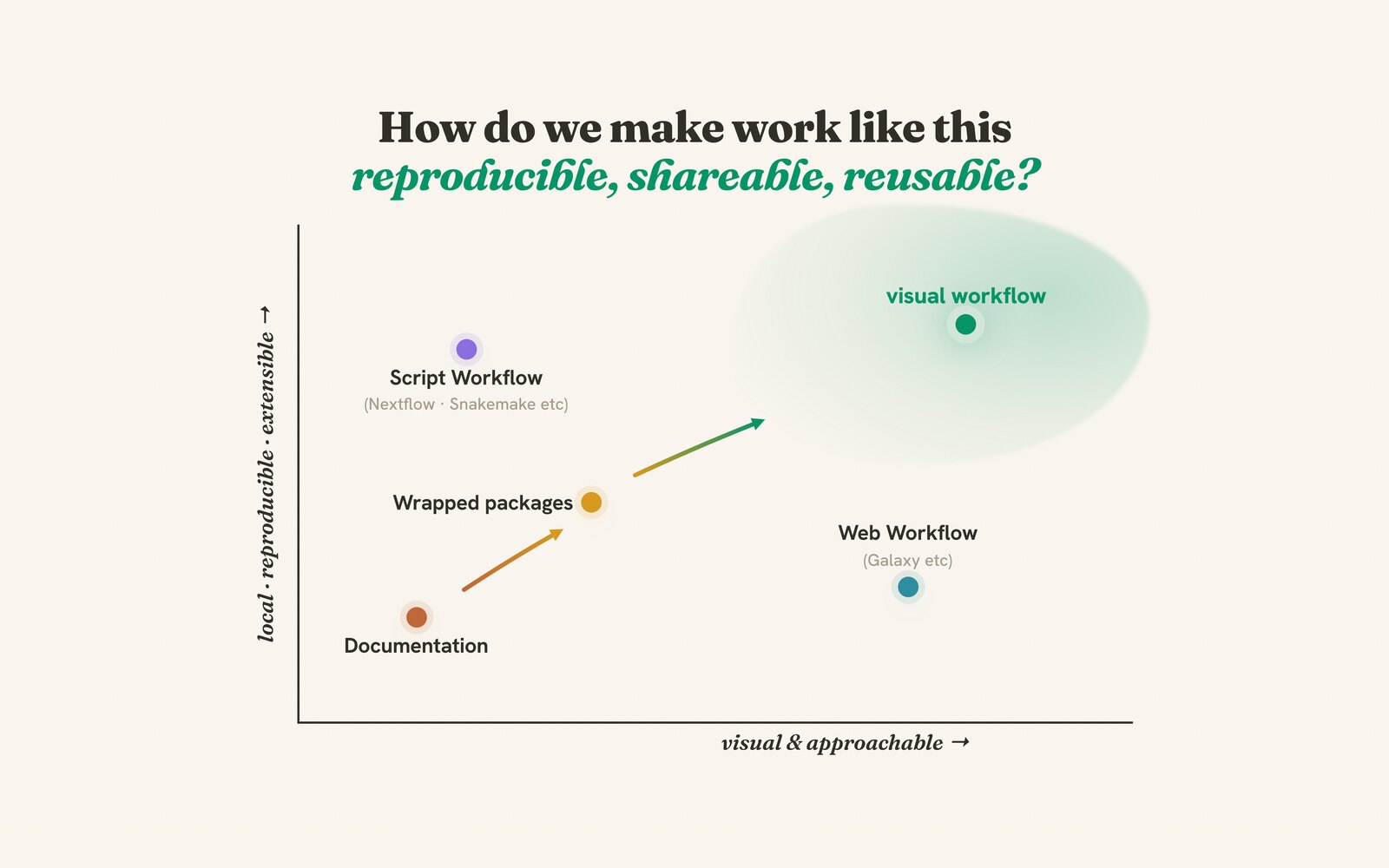
Salpa is presented at the 18th European Biological Inorganic Chemistry Conference: two metal-chemistry workflows, built entirely from open methods, run as node graphs rather than scripts. The question the talk opens with — can a researcher who doesn’t code run a metal-complex MD and docking pipeline end to end? — is the whole company, compressed.
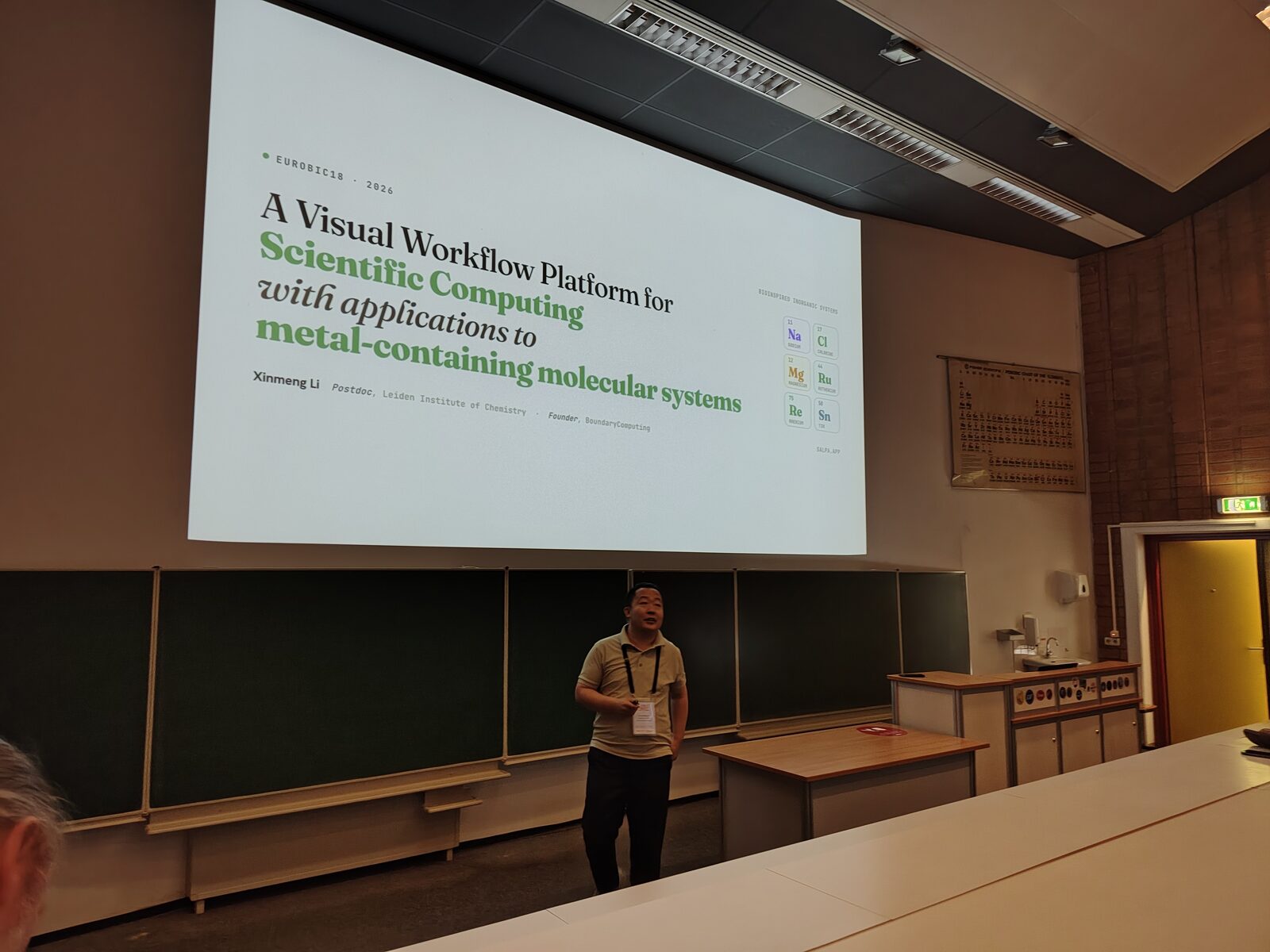
The first master’s thesis built end-to-end in Salpa: AI protein generative models, quantum-chemistry force-field parameterization, and all-atom MD chained into a single workflow, producing insight for anticancer metallopeptide design. Proof the thing works in someone else’s hands.
Five GPU nodes and a self-serve free tier: the workflows that outgrow a laptop get somewhere to go. The page flips from “early access” to “available now” the same day.
An afternoon of exchange with Drs. Taku Ozawa and Koji Okuwaki of JSOL Corporation — on J-OCTA, their long track record in multiscale modeling, recent FMO-based methods, and where simulation meets modern AI. A generous visit, and a long conversation.
Three years of evenings, part-time months and one rejected proposal ship as a downloadable application: free, on macOS, Linux and Windows. Anyone can now break it, which is the point.
Every user-visible “BoCoFlow” becomes “Salpa” — menus, window titles, log windows, the thousand small places a name hides. Renaming a product is one commit; renaming it everywhere is a fortnight.
App name, icons, splash screens. The name fits the shape of the thing: salps are small, transparent creatures that link themselves into long chains — each one complete on its own, the chain doing what no single one could.
Hardcoded colours across 72 files are migrated onto brand theme tokens. Nothing visible changes that day; every visible change afterwards gets cheaper.
A separate repository for node packages: the science stops living inside the application. Unglamorous, and the precondition for everything later called Salpa Hub.
A proposal goes out to build an open, visual platform for scientific-computing workflows. The answer, when it comes, is no. One reviewer notes that developing a complete desktop workflow-visualization tool, as one work package among several, “seems overly ambitious.” Fair, honestly. It was ambitious.
BoCoFlowBeta is taken apart in a single day and migrated into real repositories: an execution engine, a desktop shell, and the canvas the user actually touches. A prototype becomes an architecture — the moment it stops being possible to rewrite it in a weekend.
The evenings stop being enough. From January, real working hours.
“Initial commit from Create Next App.” The company gets a front door several months before it properly has a company behind it — which is, roughly, the order these things happen in.
First commit of BoCoFlowBeta — the evenings finally have a repository. It stays one directory for 230 commits, long enough to prove the idea works before anyone tries to make it an architecture.
One stubborn idea: a researcher who can formulate the question should be able to run the pipeline that answers it — without first becoming a programmer. No plan, no funding, no name. Just prototyping in free time, in the gaps around a full-time job.